Celtic Cross Sculptures
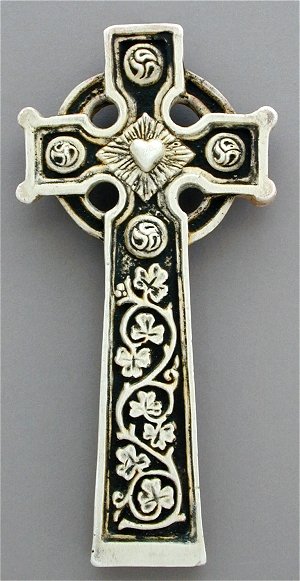
Slane Priory Cross
Slane, Co. Meath, Ireland
Above the village of Slane, the first Easter fire was lit by St. Patrick in 433 AD to symbolize the arrival of Christianity to Ireland. A monastery was built on the Hill of Slane in the 6th century, but little is known about it. The ruins atop the hill today are what remain of a Franciscan friary and college, having been ravaged in turn by Vikings, Normans and Cromwell’s troops.
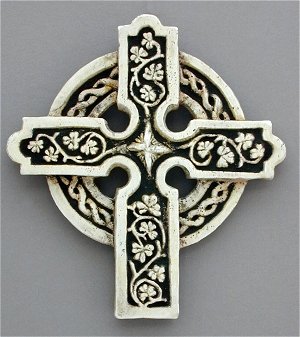
This cross design was developed and inspired by a cross at the present day ruins. The shamrocks, of course, are a symbol of Ireland and seem to represent everything Irish.The heart and rays streaming from it represent Christ, the Light of the World. The small bosses of spirals represent spiritual growth. Along the sides of the shaft we have added a well-known Irish blessing. 'May your blessings outnumber the shamrocks.'
Cross is 8 1/2 inches x 4 1/4 inches
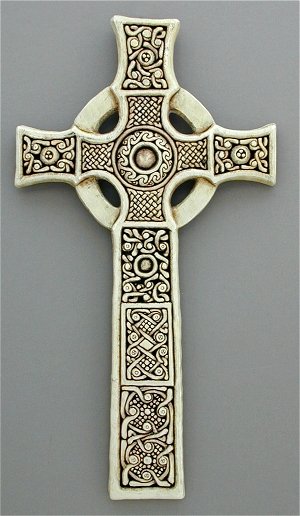
St. John's Cross
Isle of Iona, Scotland
The Isle of Iona founded by St. Columba from Ireland, occupied a key position between Pictland and Northumbria on the one hand and Ireland on the other. The community of Iona had close links with Ireland in the 8th century and it is known to have been the meeting point of different artistic traditions. St. John's Cross, which has the widest span (almost 7 feet, 3 inches.) of any early cross in Britian, was originally without a ring and because of structural weakness, the ring was added in later. The cross is 17 feet tall and is from the 8th century. The panels of serpent and boss designs and 'bird's nest' bosses, and spiral work is very similar to that on the Chi-Rho page in the Book of Kells. St. John Cross represents rebirth in Christ. The 'bird's nest' symbolizes birth and the serpents represent rebirth since the snake sheds its old skin.
Cross is 15 inches x 8 inches
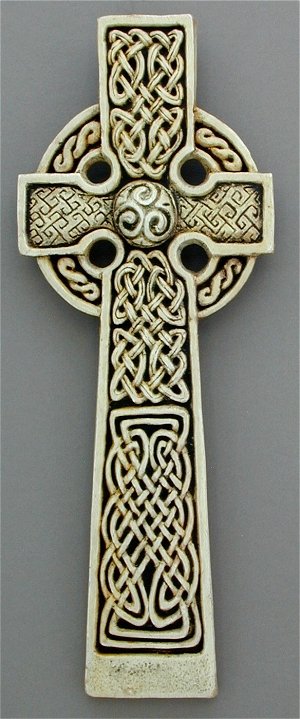
Tobermory Cross
Isle of Mull, Scotland
Tobermory is an ancient medieval seaport at the top of the Isle of Mull. Across the channel is Lochaline, the site of a 14th -15th century stone carving school that was associated with the nearby Holy Isle of Iona. This cross design is of our own invention, but incorporates all the Celtic symbols (the unending knotwork, the maze and the spirals) and was inspired by this ancient place.
Cross is 11 1/2 inches x 4 1/2 inches
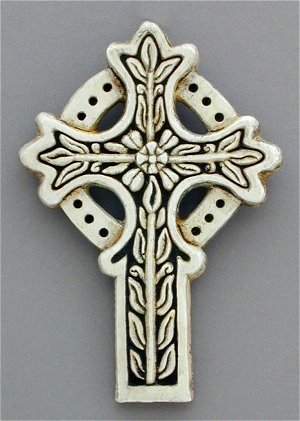
Ballymakinny Cross
Co. Louth, Ireland
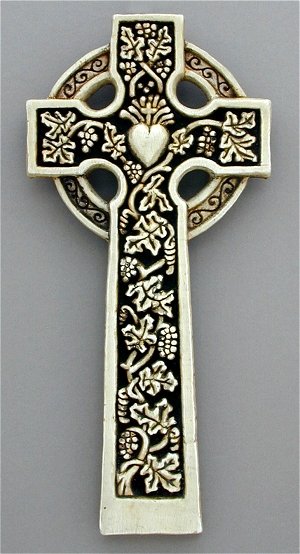
The Ballymakinny Cross is designed after the one found at Monasterboice, a former monastery that is one of Ireland's best-known and oldest religious sites. The symbolism on this small, simple, yet energetic cross is that of the Tree of Life, symbolizing life, spiritual growth and rebirth - health, hope and happiness. This cross comes with a card that reads:
May there always be work for your hands to do,
May your purse alway hold a coin or two.
May the sun always shine warm on your window pane,
May a rainbow be certain to follow each rain.
May the hand of a friend always be near you,
And may God fill your heart with gladness to cheer you
Cross is 6 inches x 4 inches
Muiredach Cross
Co. Louth, Ireland
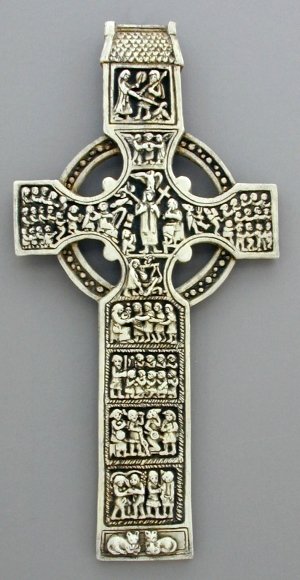
Muiredach’s High Cross is the finest of its kind in Ireland. It is found at Monasterboice, which was founded in the 5th century by an obscure disciple of St. Patrick called St. Buite. This medieval monastery is one of Ireland’s best-known and oldest religious sites, with the ruins of two churches and a Round Tower. The Cross of Muiredach, a massive 17ft 8in, 10th century monolith is remarkably well preserved despite more than 1000 years of weathering.
The scenes are from bottom upwards:
1) The Fall of Man shows Adam and Eve, and Cain slaying Abel alongside.
2) David struggling with Goliath
3) Moses smites the rock to obtain water for the Israelites
4) Adoration of the Magi
Center: The last judgment shows Christ in Glory surrounded by a crowd of resurrected souls. The devil stands on his left clutching a pitchfork, ready to chase the damned souls to Hell. Below Christ’s feet are the scales of judgment
Top: St. Anthony and St. Paul meeting in the desert.
Cross is 15 1/2 inches x 7 1/2 inches
St. Martin's Cross
Isle of Iona, Scotland
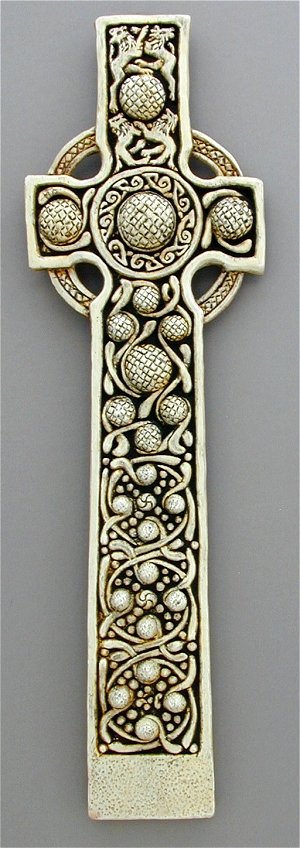
St. Martin's Cross was carved from a single slab of gray epidiorite in the mid to late 8th century. The most perfect of the surviving crosses on Iona, it stands in its original position where the monks of the island monastery placed it twelve hundred years ago. The cross, including its base is seventeen feet high and is carved from a stone that originally came from Argyll, Scotland. The raised circles, or bosses, are thought to represent God with everything revolving around Him. Intertwined between theses bosses are serpents, which in the Celtic work represented rebirth since the snake sheds its old skin; symbolizing our rebirth into a new life upon acceptance of Jesus. The ring around the cross head represents eternal life and is a common feature in Celtic Crosses.
Sculpture is 19 inches x 5 1/2 inches
Enniskillen Cross
Co. Fermanaagh, Ireland
Cross is 6 3/4 inches x 6 inches
Ballina Cross
Co. Tipperary, Ireland
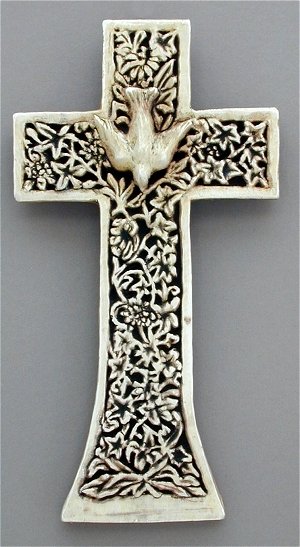
This delightful cross comes from the heart of Ireland and the won of Ballina., where the Shannon River leaves Lough Derg and rushes toward the city of Limerick and the the ocean.
The descending dove is a reference to the Bible verse, Mark 1:11, 'And when Jesus came up out of the water, he saw the heavens split open and the Holy Spirit descending like a dove on him'.
The cross is entirely covered with a lovely design of grapes, lilies and ivy.
Cross is 10 inches x 5 1/2 inches
Dromahair Cross
Co. Leitrim, Ireland
Deep peace of the running waves to you,
Deep peace of the flowing air to you,
Deep peace of the smiling stars to you,
Deep peace of the quiet earth to you,
Deep peace of the watching shepherds to you,
Deep peace of the Son of Peace to you.
St. Patrick, the patron saint of Ireland settled in this valley around AD 440 and founded a church, monastery and nunnery. Across the River Bonet from the village of Dromahair there is also Creeveless, a Franciscan Friary, which was founded in 1508 by Margaret, wife of Owen O’Roarke.
Skibereen Cross
Co. Cork, Ireland
Skibbereen is a thriving market town, regarded as the capital of the area known as The Carberies. Situated on the River Ilen, it was founded after Algerian pirates sacked the neighboring port of Baltimore in 1631 carrying off 200 inhabitants into slavery. In the 17th century it produced two battling bishops: one was killed in 1602 fighting the forces of Queen Elizabeth, and the other was hanged on Cromwell’s orders in 1650. The coastline from Ross Carber to Baltimore twists round creeks, sandy bays, harbors and headlands. To the west of Skibbereen is Mizen Head, the most southwesterly tip of Ireland. The light house Mizen Vision is reached by a bridge across a rocky chasm.
Cross is 9 3/4 inches x 4 inches
High Cross
Lochgilphead, Scotland
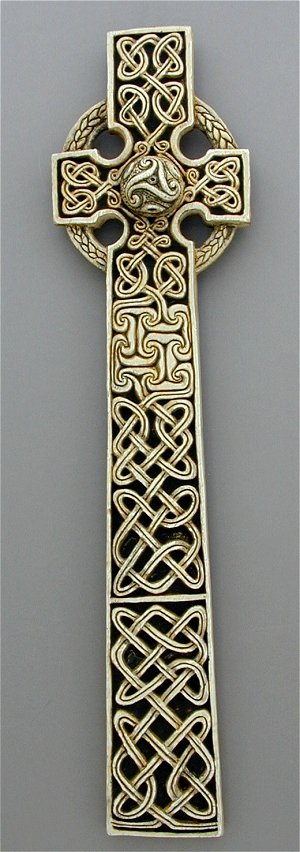
This is a memorial cross erected for those who died in WW11 from the village of Lochgilphead, Scotland. The interlacing running the length of the cross is endless. It represents the eternal theme-the Alpha and Omega-beginning and end in the eternal circle; the very essence of the Celtic Art. The raised center with its multiple spirals, symbolizes the Most High God with everything revolving around Him. The outter circle represents Heaven. This cross which is about 25 feet tall, is similar to the very ancient high crosses. It is believed that there were over 300 such crosses on the Isle of Iona in ancient times.
Cross is 23 1/2 inches x 6 inches
A descriptive tag accompanies the Ballinrobe Cross with a blessing:
May God in His wisdom and infinite love, look down on you always from Heaven above.
May He send good fortune, contentment and peace, and may all of your blessings forever increase.
The Ballinrobe cross is found in County Mayo in the west of Ireland, near Lough Mask, a lake large enough to produce choppy waves in rough weather. Nearby are the ruins of two abbeys: Inishmaina Abbey, originally founded in the 6th century by Saint Connan, and Cong Abbey, founded in the 12th century by Turlough O'Connor, High King of Ireland.
Cross is 10 inches x 5 inches
Quin Harp Cross
Quin Friary, Co. Clare, Ireland
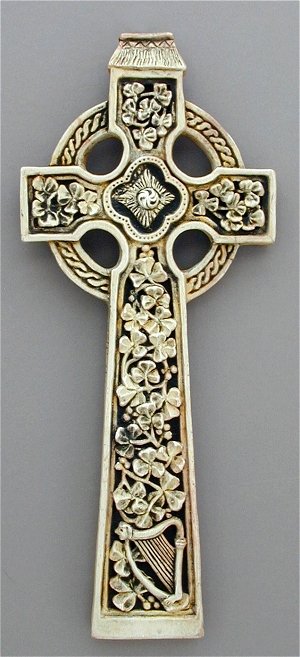
Although very old, this cross is not one of the ancient high crosses of Ireland. It does, however, echo the shape and design of those magnificent ancient monuments. The Harp Cross is located among the ruins of the Quin Friary and is approximately 11 feet high. Quin was founded as a Franciscan Friary in 1433. It was built in the ruins of a much older anglo-Norman castle. In 1541, King Henry VII dissolved the friary in his campaign to control the wealth and power of the church. Carved into the face of the cross is an Irish harp and scores of shamrocks. Both have become famous symbols of Ireland. The harp figures into many of the old Irish myths. The shamrock is from a legend about St. Patrick that says he used a shamrock with its three leaves to explain the Trinity, the triple nature of God.
Cross is 14 1/4 inches x 6 inches
|